
TPO and Market Profile fundamentals
Value area, point of control, single prints — the auction, organised by time at price.
A Market Profile reorganises the session by a simple question: how much time did the market spend at each price? Each half-hour gets a letter, each letter is stacked at the prices it touched, and the result is a distribution — usually a bell — that shows where the auction found acceptance and where it was rejected.
The three structures that matter
The point of control — POC — is the price with the most time, the session’s fairest price by the market’s own vote. The value area wraps roughly seventy percent of activity around it: inside is where business was accepted. And single prints — prices touched by only one letter — mark where the market moved so fast that no business was done at all.
Rejection is the useful one. Fair prices attract trade; unfair ones repel it. A long tail of single prints below the low is the auction saying “not here, not today” — and those tails, along with the edges of value, are the levels the next session actually respects.
Reading a finished profile
- Fat symmetrical profile: a balanced day. The market agreed on value and rotated around it.
- Thin elongated profile: a trend day. Value kept migrating and never settled.
- Two distinct bells: a double distribution — the market changed its mind mid-session, and the thin zone between the bells becomes the fault line.
- POC far from the close: the day ended away from its own fair price, leaving unfinished business one way or the other.
Why pair profile with positioning
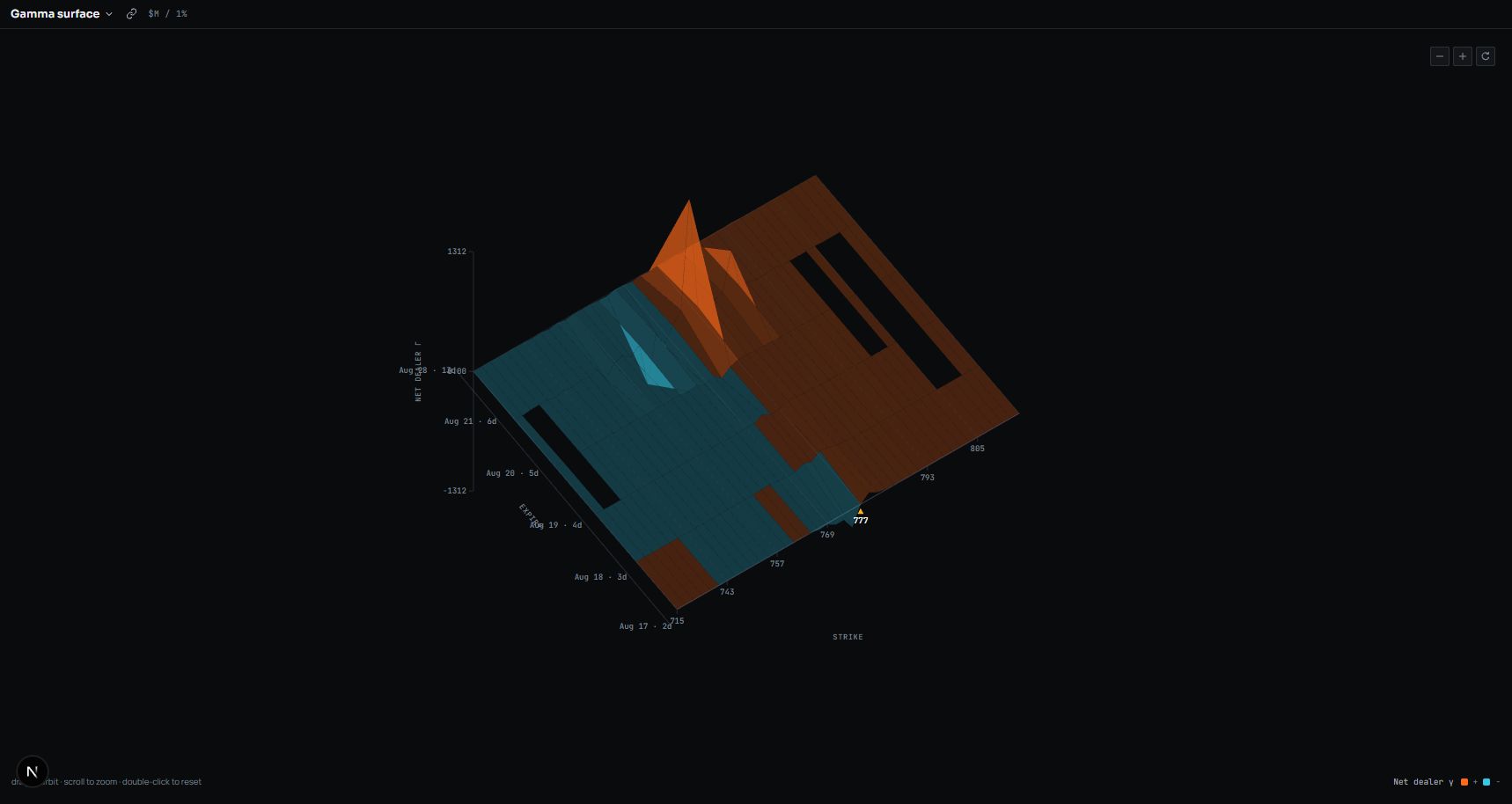
TPO tells you where the market found value; GEX tells you where hedging pressure lives. When a value-area edge and a gamma wall land on the same price, two unrelated mechanisms are pointing at one level — and levels with two reasons behave better than levels with one.
Sources and further reading
The research this guide leans on. Citations rather than links, so they stay verifiable after journal URLs move.
- Steidlmayer, J.P. and Koy, K. (1986). Markets and Market Logic. Porcupine Press.
- Dalton, J.F., Jones, E.T. and Dalton, R.B. (1990). Mind Over Markets. Traders Press.
- Chicago Board of Trade (1984). CBOT Market Profile. Exchange manual — the original specification.