
Trading around dealer levels
Turning a positioning map into entries, stops and targets without pretending it is a signal.
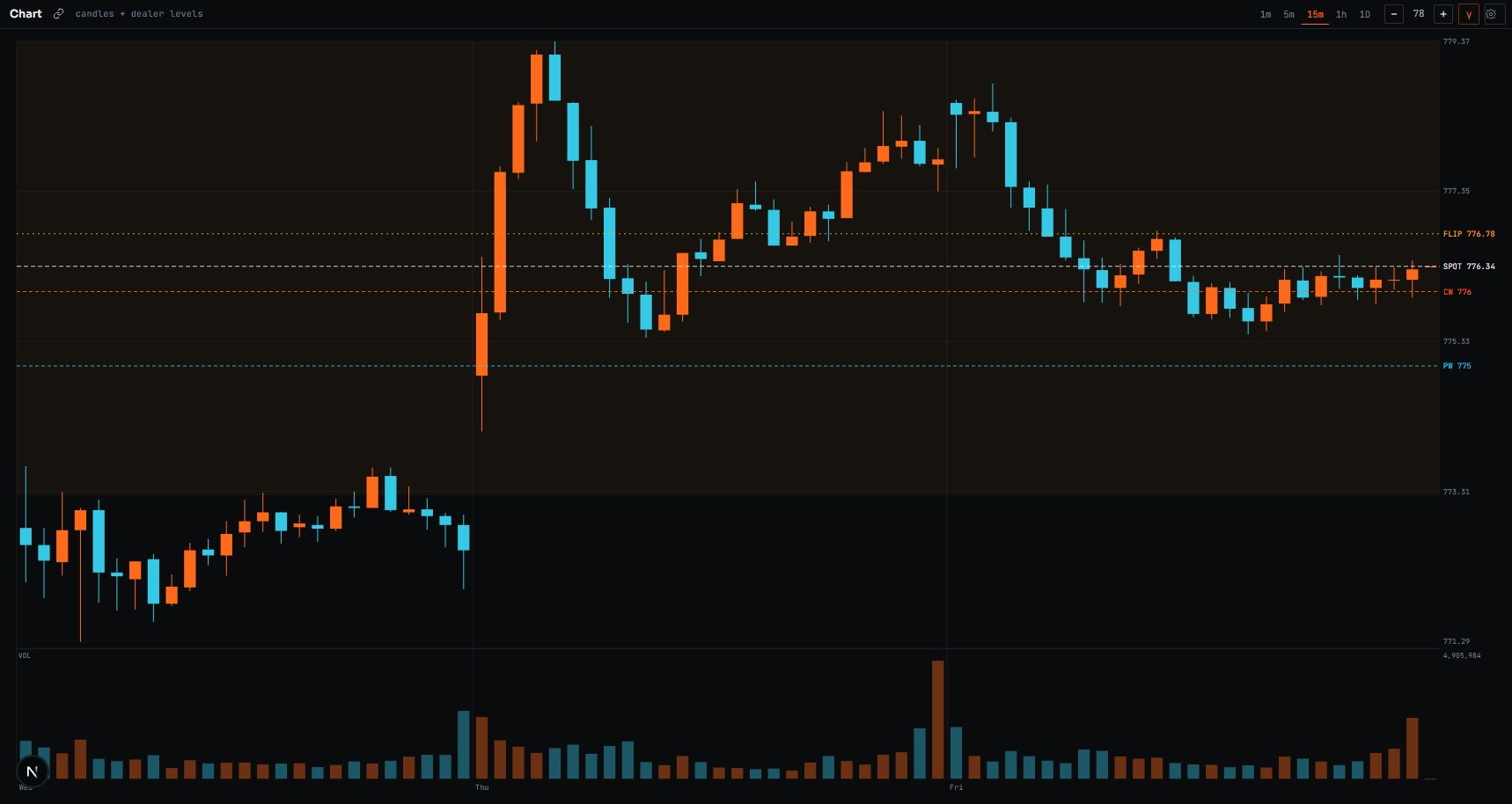
A level is not a trade. A level is a price where you expect the market’s behaviour to change — and the trade is built from how it actually behaves when it gets there. That distinction is the whole discipline of trading positioning well, and skipping it is how a good map produces bad trades.
The two honest plays at a wall
The fade: in positive gamma, price reaching a heavy wall meets hedging that leans against it. The entry is not the touch — it is the confirmation, when the tape shows the lean working: extension stalling, delta flattening, responsive trade appearing. Stop beyond the wall where the thesis is simply wrong; target back toward the heavy strikes that anchored the day.
The break: when a tested wall gives way — especially with the regime negative — the hedging that resisted becomes fuel. The entry is acceptance beyond the level, not the first poke through it; the failed retest from the far side is the cleanest trigger the pattern offers.
Stops that mean something
Levels give stops meaning. A stop placed just beyond a wall is not a pain threshold — it is the price at which the mechanical reason for the trade has been disproven. If you cannot say what invalidates the idea, the level is decoration and the trade is a coin flip with extra steps.
Confluence is the filter
- One reason (a wall) is a place to watch. Two reasons (a wall on a value-area edge) is a place to plan.
- Three independent reasons — positioning, profile, and live order flow agreeing — is as good as it gets. Size accordingly, which mostly means: only then.
- Distance matters: a level three percent away is context; the same level one tick away is a decision.
Sources and further reading
The research this guide leans on. Citations rather than links, so they stay verifiable after journal URLs move.
- Baltussen, G., Da, Z., Lammers, S. and Martens, M. (2021). Hedging demand and market intraday momentum. Journal of Financial Economics 142(1).
- Ni, S.X., Pearson, N.D., Poteshman, A.M. and White, J. (2021). Does Option Trading Have a Pervasive Impact on Underlying Stock Prices? Review of Financial Studies 34(4).
- Harris, L. (2003). Trading and Exchanges: Market Microstructure for Practitioners. Oxford University Press.