
Max pain is not a magnet
What the number actually measures, why it sometimes "works", and when to ignore it.
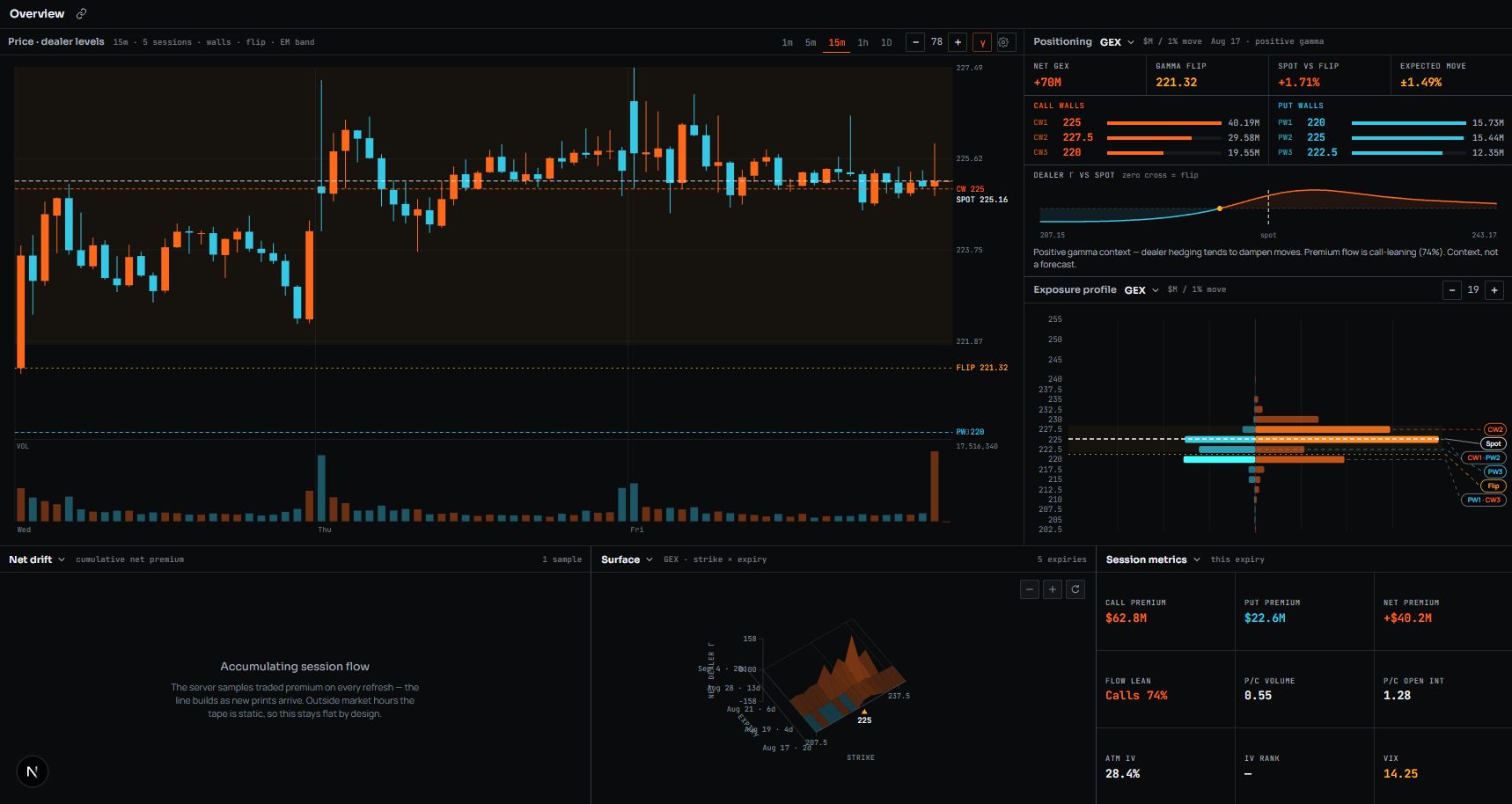
Max pain is the expiry price that would pay option holders, in total, the least — computed by summing what every open contract would be worth at each candidate strike and taking the minimum. The folklore says price is drawn there so that “the market makers win.” The folklore overclaims.
What the number really is
It is an open-interest summary, nothing more. It says where the book’s payouts would be smallest; it does not identify anyone with both the incentive and the firepower to put price there. Dealers are hedged — their profit is not the mirror image of option holders’ losses, and they are not steering spot to a strike.
Why it sometimes looks right anyway
Heavy open interest creates real pinning through gamma: dealers hedging large near-the-money strikes generate two-sided flow that slows price down near them. Max pain often lands near those same heavy strikes, because both are computed from the same open interest. When max pain “works,” it is usually gamma doing the work and max pain taking the credit.
The two numbers also disagree often enough to matter. Across boards we measured, the minimum-payout strike and the flip point differ roughly a third of the time — usually by a strike, occasionally by many. Treating them as interchangeable is how a level ends up drawn several strikes from anything real.
How to actually use it
- Glance at it on expiry morning as one more marker of where the book is heavy.
- Trust the gamma profile over max pain whenever they disagree — the profile models the flows, max pain models a payout.
- Drop it entirely once expiry passes. It is a statement about one date.
Sources and further reading
The research this guide leans on. Citations rather than links, so they stay verifiable after journal URLs move.
- Ni, S.X., Pearson, N.D. and Poteshman, A.M. (2005). Stock price clustering on option expiration dates. Journal of Financial Economics 78(1).
- Avellaneda, M. and Lipkin, M.D. (2003). A market-induced mechanism for stock pinning. Quantitative Finance 3(6).