
The expected move and event premium
What the straddle is telling you before earnings, the Fed, and every other scheduled scare.
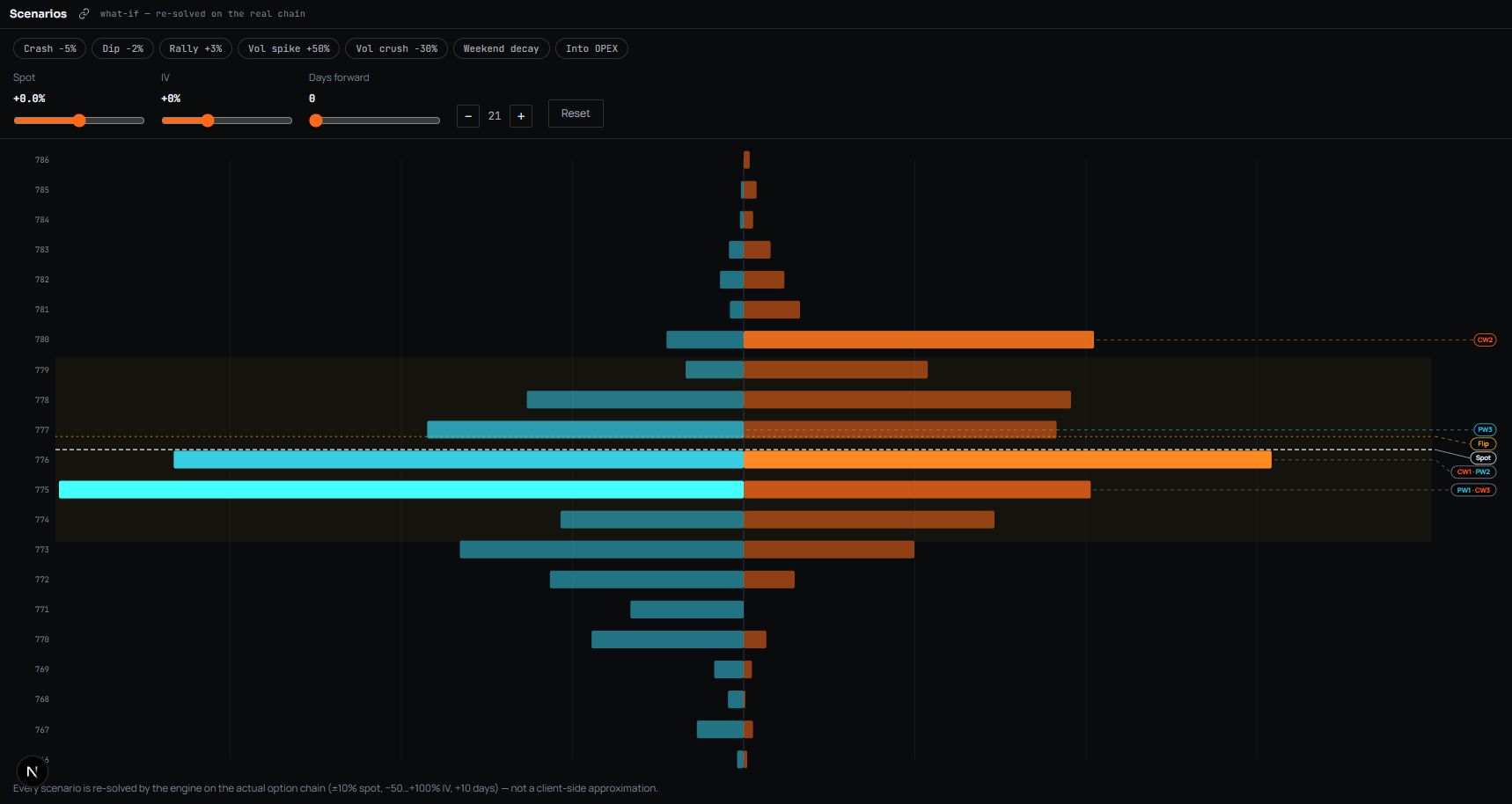
Before every scheduled event, the option market publishes a forecast: the expected move, read straight from the price of the at-the-money straddle. It is the market’s own estimate of how far price travels through the event — and unlike most forecasts, someone is paid or punished for its accuracy.
Reading it
The nearest-expiry straddle price, as a percent of spot, is the move being charged for. A stock at 200 with the event-week straddle at 12 dollars carries a six percent expected move. Nothing about direction — options price distance, not sign.
The useful comparisons are historical: is six percent large for this name’s last eight earnings? Did it actually deliver that on any of them? Names that habitually deliver half their expected move are telling you who usually wins the event trade there.
Event premium and the crush
Implied vol into an event is two things stacked: everyday vol plus a premium for the known unknown. The moment the event prints, the second part evaporates — the crush. This is why a stock can move three percent on earnings and the calls still lose: the move arrived, but smaller than the premium that was charged for it.
The crush is also a spot flow. As implieds deflate, vanna unwinds hedges — frequently a mechanical bid under the market on the morning after, independent of whether the news was good.
Practical uses
- Frame post-event levels: spot plus and minus the expected move are where the option book breaks even, and price behaviour changes character beyond them.
- Judge any options trade through an event against the premium, not against your directional view alone.
- Watch the after: positioning rebuilt post-event, with the premium gone, is a cleaner map than anything drawn the day before.
Sources and further reading
The research this guide leans on. Citations rather than links, so they stay verifiable after journal URLs move.
- Patell, J.M. and Wolfson, M.A. (1979). Anticipated information releases reflected in call option prices. Journal of Accounting and Economics 1(2).
- Dubinsky, A., Johannes, M., Kaeck, A. and Seeger, N.J. (2019). Option Pricing of Earnings Announcement Risks. Review of Financial Studies 32(2).
- Carr, P. and Wu, L. (2009). Variance Risk Premiums. Review of Financial Studies 22(3).