
Charm, vanna and the 0DTE clock
Why the afternoon drifts, why vol spikes move spot, and what expiry does to both.
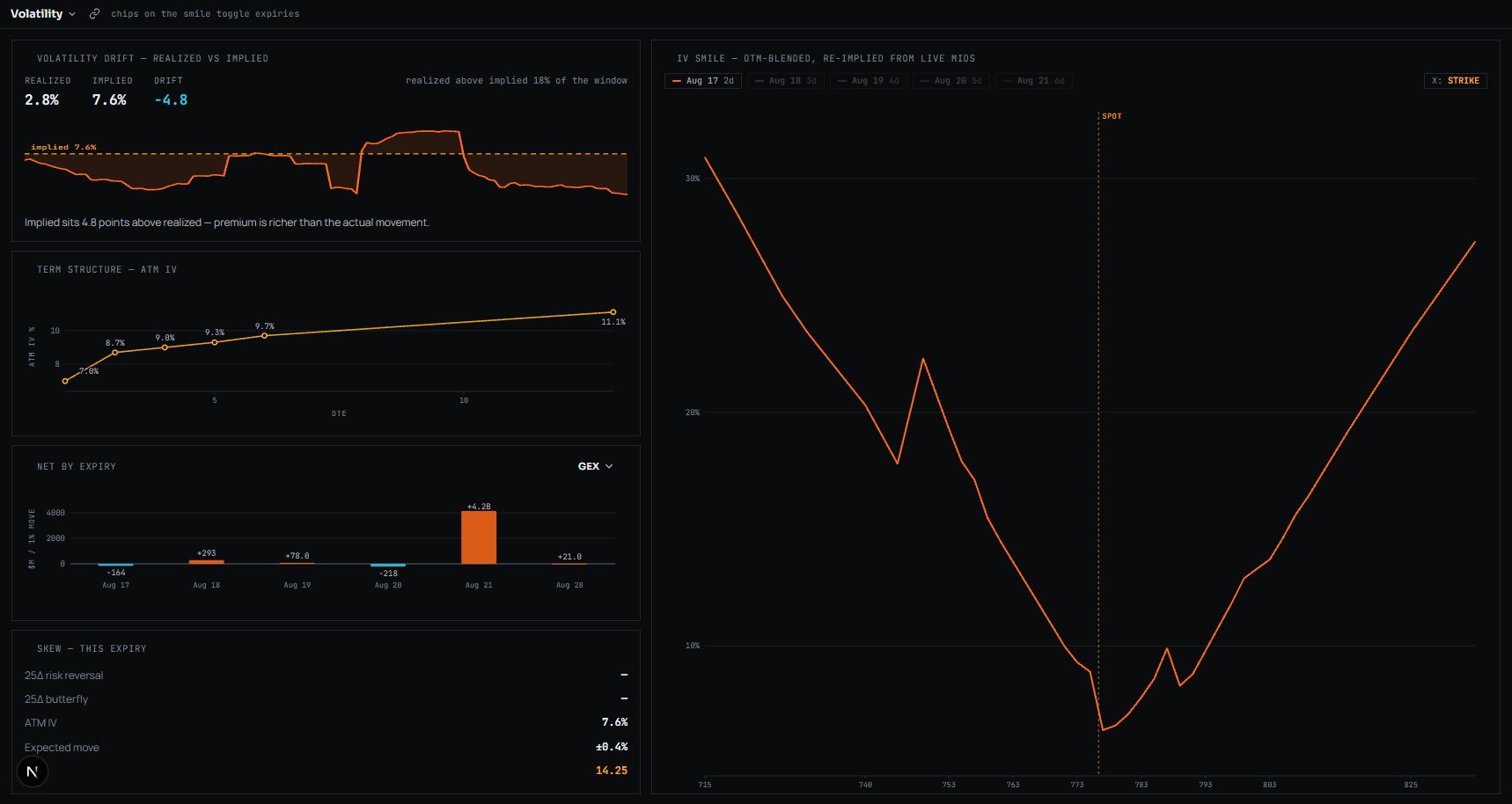
Gamma explains hedging against price. But dealer deltas also move when nothing happens to price at all — they decay with time and they shift with implied volatility. The first effect is charm, the second is vanna, and between them they explain some of the most reliable intraday flows in the market.
Charm: hedges that melt
Charm is the change in delta from the passage of time. An out-of-the-money option drifts toward zero delta as expiry approaches; an in-the-money one drifts toward a full hundred. Every dealer hedge keyed to those deltas has to follow.
On expiry days this is not a rounding error. A large block of out-of-the-money puts losing delta all afternoon means dealers who were short stock against them steadily buy it back — a mechanical bid that builds into the close and has nothing to do with news. On days dominated by same-day options, charm is frequently the largest flow on the tape.
Vanna: hedges that move with fear
Vanna is the change in delta from a change in implied volatility. When vol falls, out-of-the-money options shed delta, and the hedges against them unwind — which in a market positioned short puts typically means dealers buying stock as fear drains out.
This is the machinery behind “vol down, spot up” afternoons and post-event rallies that seem to run on nothing: the event passes, implieds deflate, vanna flows do the lifting.
Why 0DTE changed the day’s shape
Same-day options concentrate enormous gamma at whatever strike price is nearest, and both charm and vanna act on it with only hours left. The result is a day with phases: a morning where positioning is being established, a midday where pinning to heavy strikes is strongest, and a final ninety minutes where decay flows dominate and the pin either holds or snaps.
The practical reading: the same strike can be a magnet at noon and irrelevant at 3:45, because the exposure behind it has simply expired out from under it.
Sources and further reading
The research this guide leans on. Citations rather than links, so they stay verifiable after journal URLs move.
- Taleb, N.N. (1997). Dynamic Hedging: Managing Vanilla and Exotic Options. Wiley.
- Hull, J.C. Options, Futures, and Other Derivatives. Pearson — the chapters on higher-order sensitivities.
- Beckmeyer, H., Branger, N. and Gayda, L. (2023). Retail Traders Love 0DTE Options. Working paper.
- Ni, S.X., Pearson, N.D., Poteshman, A.M. and White, J. (2021). Does Option Trading Have a Pervasive Impact on Underlying Stock Prices? Review of Financial Studies 34(4).